

Can a class you’re paying for with financial aid actually reduce the Pell Grant you expected to receive? It can, and the reason may have less to do with how many credits you take than whether those credits count toward your degree.
Pell Grant classes that don’t count toward your degree may be excluded when your school calculates eligible enrollment. Even if a course appears on your schedule and earns college credit, it may not count toward your active degree or certificate. This can affect your Pell Grant enrollment intensity and potentially change your award.
The problem often surfaces when students change majors, add electives, repeat courses, or register for classes outside their declared programs. A schedule showing 12 credit hours does not necessarily mean all 12 credits qualify for Pell Grant calculations. And if your degree audit and financial aid records disagree, you could face an unexpected adjustment.
In this guide, you’ll learn which classes may not count toward your Pell Grant, how eligible credits affect enrollment intensity, and why federal Pell rules differ from those governing other forms of financial aid. You’ll also discover what to ask your academic advisor and financial aid office before dropping or adding a course, including how to resolve conflicting records and avoid preventable surprises.
Key Takeaways
- Check degree applicability: Pell Grant calculations generally include courses that apply to your active degree or certificate, subject to qualifying exceptions.
- Verify your eligible credits: Your registered credit total may differ from the number used to calculate your Pell Grant.
- Understand elective rules: An elective may count if it satisfies an approved program requirement and applicable limits.
- Check other financial aid separately: State grants, institutional scholarships, and other aid may follow different eligibility rules.
- Get confirmation before changing your schedule: Ask your school to explain the course’s eligibility, the timing of any recalculation, and the potential effect on your award in writing.
Do Pell Grant classes have to count toward your degree?
Generally, yes: for Pell enrollment calculations, a course must apply to your degree or certificate, or qualify as remedial coursework tied to your course of study. The U.S. Department of Education’s 2026–27 Federal Student Aid Handbook, Volume 7, Chapter 3, states this requirement in its guidance on correspondence courses and enrollment intensity. The broader Pell chapter explains that enrollment intensity measures a student’s eligible enrollment relative to full-time.
That distinction matters. Your registration page might show 12 credits, while only 9 credits apply to the credential in your student record. If the other 3 credits are outside the program and do not fit an allowed exception, your Pell calculation may use the eligible 9 rather than the full schedule. Do not assume that the portal’s credit total and the aid office’s Pell enrollment total are identical.
For a standard-term undergraduate program, federal rules require the school to define full-time enrollment at no fewer than 12 credit hours. Pell enrollment intensity is calculated as eligible credits divided by the school’s full-time credit threshold, rounded to a whole percentage. With 9 eligible credits and a 12-credit threshold, the handbook’s method yields 75% intensity. That example illustrates the formula, not a promise about a particular student’s dollar amount.
Read the official Federal Student Aid Handbook chapter on Pell enrollment intensity alongside your college’s own policy. The handbook also says schools should not apply Pell enrollment-intensity guidance to other Title IV programs. Other aid may use different enrollment rules.
Which classes may not count as Pell-eligible coursework?

A course may be excluded when it does not apply to your declared program, even if it earns college credit or seems related to your career plans. The deciding question is usually whether the course satisfies a program requirement, an accepted elective slot, or an applicable remedial-work rule in your school’s records.
Courses outside your declared program
A class for a different major may not count toward your current credential. For example, a student pursuing an accounting certificate might register for a biology course while considering a health program. The course can be worthwhile, but unless it satisfies an approved requirement or elective under the student’s active program, it may not count in Pell enrollment intensity.
Changing your major does not automatically make every previously chosen class eligible. The school needs to determine which program is active and whether credits fit its requirements. Ask how the effective date of a program change interacts with the term’s enrollment review.
Extra electives and courses beyond a requirement
An elective is not automatically ineligible. It may count when the degree audit allows electives in that category and you have room to use the credits. But a course can stop satisfying the plan after the requirement has been filled, or it may sit outside the accepted elective list. Confirm the audit result rather than relying on the course title.
This is especially important when you add a class to reach a higher credit load. A 3-credit addition can change your schedule without changing your Pell-eligible enrollment if it does not apply to your program.
Remedial coursework and exceptions
Some remedial work can be included under federal rules, but that does not mean every developmental, preparatory, or noncredit class is automatically Pell eligible. The course must meet applicable federal conditions and the school’s program rules. Ask the aid office to identify the specific basis for counting it.
Do not treat a verbal statement such as “developmental courses are covered” as a complete answer. Ask whether this exact course and section qualify for your program and term.
Why your credit total can mislead you about Pell

Your registered credits are not always the same as your eligible credits for Pell. Pell enrollment intensity uses the applicable enrollment measure, and the course-eligibility decision can change the credits included in that measure. So the number beside “credits enrolled” in a portal may not settle your award question.
Use a simple check. First, ask the school how many credits in your schedule apply to your active degree or certificate. Then ask what full-time credit threshold it uses for your program and term. Finally, ask how those inputs affect the Pell enrollment-intensity percentage and award estimate.
For instance, if your schedule lists 12 credits but 3 are not applicable, the aid office may evaluate 9 eligible credits. If the full-time threshold is 12, that is 75% intensity under the handbook formula. The actual award still depends on your eligibility and the school’s calculation; do not multiply your grant by a percentage and assume that result is final.
Course eligibility can also change after registration. A late program update, transfer-credit evaluation, substitution approval, or degree-audit correction may alter which courses count. Ask whether your school reviews eligibility at a set point or updates it when your record changes.
What to do before dropping or adding a class
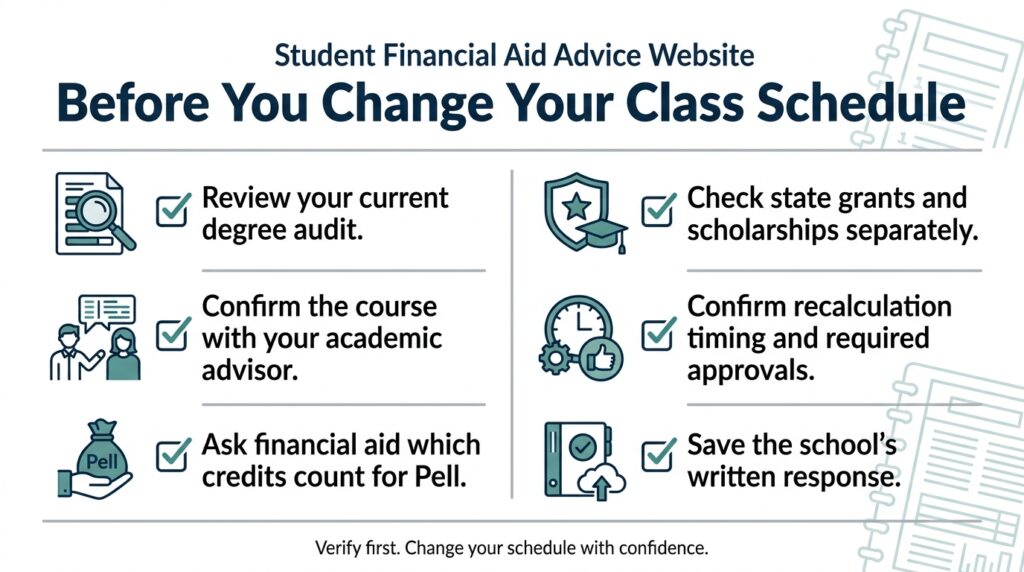
Get a course-level eligibility answer before changing your schedule, then ask the aid office to recalculate the effect. A course-by-course check is faster than trying to repair an award after the schedule, program, or census review has moved on.
- Open your current degree audit. Confirm your active program and note whether the course fills a named requirement, elective slot, or approved substitution.
- Ask an academic advisor about the program fit. Request an explicit answer about this course, not just whether it is “useful” or transferable.
- Ask financial aid which credits count for Pell. Include the course number, section, term, and your active program. Ask for the eligible-credit count before and after the proposed change.
- Check other aid separately. State grants, institutional scholarships, and tuition programs may use different rules. Ask which specific award could change.
- Ask about timing and documentation. Find out whether the change triggers a Pell recalculation, when the school processes it, and whether approval or an updated degree audit is needed.
- Save the response. Keep the email or case number, then compare your account after the school processes the change.
If the choice is between dropping a course and staying enrolled, review the broader consequences too. Our guide to how dropping versus withdrawing can affect your financial aid explains why the action and timing matter. Students weighing a credit-load change can also read what happens to Pell when you drop below 12 credits and the guide to Pell Grant recalculation dates before dropping a class.
How course eligibility connects to other financial aid risks
A class that does not count toward your program can affect more than the Pell estimate, but each aid program has its own rules. The cleanest approach is to ask about each award by name instead of assuming that one answer covers your full aid package.
Federal Student Aid’s Pell guidance describes enrollment intensity for Pell. That should not be casually transferred to loans, campus-based aid, state grants, or college scholarships. A school may evaluate those programs with separate enrollment definitions or program-specific conditions. The University of Denver’s aid-eligible coursework page, for example, describes a distinction between Pell and other aid in its own institutional policy. It is useful as an illustration of variation, not as a rule for your college.
Schedule changes can also create separate risks. Withdrawing may raise return-of-funds questions depending on attendance and timing. A course that remains on the transcript with a failing or withdrawn grade can affect satisfactory academic progress. Read our guide to the SAP completion pace rule and what Pell changes when you never attend a class before assuming the only issue is current-term grant dollars.
The practical lesson is simple: a degree-audit decision is an input to aid eligibility, while dropping or withdrawing may create additional consequences. Have the college review both questions before you act.
What if your degree audit and financial aid office disagree?
Ask the school to reconcile the records in writing before making an irreversible schedule change. A degree audit may show a course as an elective while the aid system flags it as outside the program. That is a records problem to resolve, not a reason to guess.
Send a concise message with your student ID through the school’s secure channel, the course and term, your active credential, and a screenshot or name of the degree-audit requirement. Ask the office to explain whether the course will count toward Pell enrollment and which record needs correction. Avoid sending sensitive personal information through ordinary email unless the college instructs you to do so.
If an advisor has approved a substitution, ask whether that approval has been entered in the official system and whether financial aid can see it. A conversation in an advising appointment may not update the degree audit automatically. Follow up until the approval appears in the record the aid office uses.
For advisors and administrators, the operational fix is to flag aid eligibility during schedule-change conversations. A short “does this course apply to the active program?” check can prevent a student from mistaking registered hours for Pell-eligible hours. That is a better point of intervention than explaining an unexpected recalculation after the student has already changed enrollment.
Before you change your schedule
When a course’s place in your program is unclear, pause long enough to verify it. The course’s relationship to your active credential can matter more to Pell than the credit total displayed on your schedule. That is why I would make course applicability a required checkpoint before any schedule change, then have the aid office confirm the award effect in writing.
Check your degree audit, ask about the specific course, and separate Pell questions from questions about state or institutional aid. If you have already made the change, contact financial aid promptly and keep a record of the response. For more practical guidance before dropping, adding, or withdrawing from a class, subscribe to StudentAidGuard and explore the related schedule-change guides above.
Frequently asked questions
Will Pell pay for a class that is not required for my major?
Possibly, if it fills an accepted elective or another requirement in your active degree or certificate. If it does not apply to the program and no applicable exception covers it, the school may exclude it from Pell enrollment calculations. Ask your college to review the exact course.
Can an elective count toward Pell Grant enrollment?
Yes, when the elective fits your program’s approved requirements and has not exceeded an applicable limit. The word “elective” alone does not decide eligibility. Check your degree audit and ask the financial aid office how the course is coded.
Does changing my major make my current classes ineligible?
It can change which courses apply, but the result depends on the courses, the new program, and the school’s record-update process. Ask when the change becomes effective for aid review and whether prior course approvals remain valid.
Will an ineligible course reduce my Pell Grant immediately?
It may affect the eligible enrollment used in a Pell calculation, but timing and recalculation depend on the facts and school procedures. Ask for the before-and-after eligible-credit count and a written award estimate before changing registration.
