
✓ AID CALCULATOR · FREE FOR COMMUNITY COLLEGE STUDENTS
See What Happens to Your Grant Before You Change Your Schedule
Every semester, a community college student drops a class, picks up a second job, or shifts to part-time hours. And somewhere in that decision is a number they never saw — the exact dollar amount their aid just changed. StudentAidGuard shows you that number before you act.
- Based on federal Pell Grant rules
- Results in under 60 seconds
- 100% Free to Use
Every Semester, Millions of Students Make Schedule Decisions Blind.
Federal and state grants are tied to strict enrollment rules — credit hours, GPA minimums, and Satisfactory Academic Progress standards. Students change their schedules every semester without realising what’s at stake. The bill arrives weeks later, after the recalculation has already happened.

✓ 6.4M At-Risk Students
Pell Grant promises
Your Pell Grant is tied directly to how many credits you carry. Drop below a threshold and the government automatically cuts what you receive — without sending a warning.
SAP violations
Satisfactory Academic Progress is tracked every semester. One bad term — or one too many withdrawals — can suspend your grant entirely, not just reduce it.
Loan eligibility cutoffs
Drop below half-time and your federal loans can shift into repayment status earlier than you expected. Most students find out after it happens.
“Financial aid offices are understaffed. Students are under-informed. The rules exist — but no one ever built a tool to translate them into plain language for specific students, in that specific moment. Until now.“
HOW IT WORKS
Three Inputs. One Clear Answer.
Before the Deadline.
and Pell eligibility — and gives you a plain-English answer.
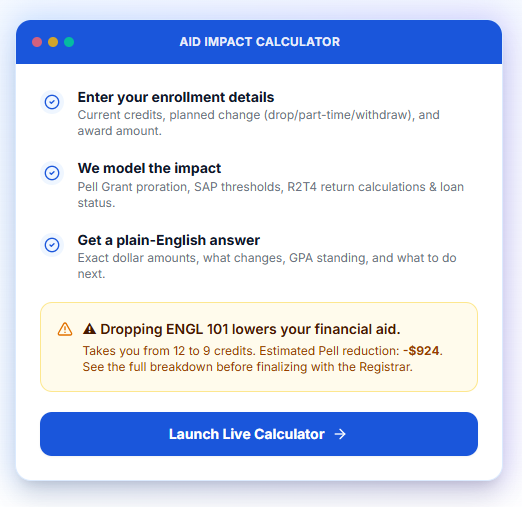
1. Enter your enrollment details
How many credits you carry right now, what aid you receive, what change you're considering — a drop, a withdrawal, a shift to part-time, fewer hours.
2. We model the federal rules
We apply enrollment intensity formulas, Pell tier thresholds: full-time (≥12 credits), half-time (≥6), SAP completion rate standards, and R2T4 calculations to your situation.
3. You get a plain-English answer
Not a PDF. Not a referral to another office. A specific result: exact dollar impact on your Pell Grant, whether your SAP standing is at risk, whether loan eligibility changes, and what to do next.

“Will dropping BIO 201 hurt my financial aid?”
⚠ Vague. Anxious. No clear path forward.
Dropping BIO 201 takes you from 12 to 9 credits (three-quarter time).
- Your Pell Grant decreases by $924 this semester ($3,697 → $2,773).
- Your SAP completion rate is unaffected.
- Action plan: Talk to your advisor before Friday's census deadline.
Want to see what happens with your own credit schedule?
The gap is Real. The Need is Urgent.
Federal aid rules shouldn’t require a master’s degree in finance to navigate.
6.4M
ENROLLED STUDENTSCommunity college students currently enrolled and financially vulnerable to sudden aid disruption.
+3%
ENROLLMENT SURGEIncrease in community college enrollment last year — more students making more schedule decisions with less financial clarity.
28.3%
SHIFT TO PART-TIMEShare of full-time community college students who shift to part-time during enrollment — often without checking aid impact.
$150
ADVISING BUDGET / STUDENTAverage spent on financial aid advising per student — yet one missed credit threshold can cost hundreds or thousands in lost grants.
Aid impact warning — real example
Dropping ENGL 101 reduces your enrolled credits from 12 to 9. At 9 credits, your Pell Grant drops from $3,697 to $2,773 this semester — a loss of $924. Your state grant may also be affected. Talk to your financial aid office before withdrawing.
Every Other Tool Answers the Wrong Question.
General college calculators answer, “How much will college cost?” StudentAidGuard answers,
“What happens to my aid if I make this change?” — before the deadline arrives.
Feature
StudentAidGuard
Federal Aid Estimator
College Board Calc
CollegeData / Vine
- Yes
- No
- No
- No
- Yes
- Generic
- No
- Generic
- Yes
- No
- No
- No
- Yes
- No
- No
- No
- Yes
- No
- No
- Partial
- Yes
- Limited
- No
- No
- Yes
- No
- Partial
- Partial
- Yes
- Yes
- Partial
- No
The other tools above all answer the same stage-one question: “How much could college cost me?” They stop at enrollment. StudentAidGuard starts at enrollment and answers “what should I do right now?” — which is the question that actually matters.
Built for Students. Trusted by Advisors.
Choose how you want to put StudentAidGuard to work.
- 100% FREE
For Students
Check your aid risk before dropping a class, shifting to part-time, or withdrawing. Know the dollar impact before you click submit. Free, no login required.
- Pell Grant proration modeling
- SAP threshold analysis & GPA check
- Loan eligibility check
- Plain-English results, instant & downloadable
For Advisors
Share a direct link with at-risk students. Get a consistent, plain-English explanation of aid rules your students can act on without a 45-minute appointment.
- Unlimited student calculations
- Downloadable official PDF reports
- SAP appeal letter templates
- Priority email support & advisor dashboard
For Financial Aid Offices
White-label or embed the calculator on your student portal. Reduce avoidable student aid losses without adding to your advising caseload.
- Bulk student account management
- LMS & student portal iframe embed support
- Staff training resources & policy config
- Dedicated account manager & SLA
Student calculator is always 100% free. Institutional partnerships and custom integrations available on request.
Student Voice
The Warning Nobody Gave Them


Common Questions
Don't let a schedule change cost you thousands.
Questions? Email our team at contact@studentaidguard.com