
Sometimes, stepping away from college is not a choice you want to make. An unexpected financial problem, health concern, family responsibility, or change in personal circumstances can force you to withdraw from classes, even when finishing the semester was your original plan. But before you submit that withdrawal request, there is something important you need to understand: leaving college can affect more than your academic record. It can also change how much financial aid you are allowed to keep.
If you receive federal financial aid, withdrawing from every class before the end of a payment period may trigger a federal calculation called Return of Title IV Funds (R2T4). Depending on when you withdraw, your college may have to return some of your financial aid, potentially leaving you with an unexpected balance to pay.
So, does withdrawing mean you must repay your Pell Grant? What happens if you leave after the 60% point? And why might you still owe your college even after your financial aid has been adjusted?
This guide answers these questions and explains how R2T4 works, which federal aid programs are affected, how schools calculate earned and unearned aid, and when you might qualify for a post-withdrawal disbursement. You’ll also learn how modular courses, Pell Grant recalculations, and satisfactory academic progress can affect your situation.
Most importantly, you’ll discover what to ask your financial aid and student accounts offices before withdrawing so you can understand the potential financial consequences and make an informed decision.
Key Takeaways
- R2T4 applies to complete withdrawals: Dropping one course while remaining enrolled in another eligible course does not automatically trigger the calculation.
- The 60% point matters: Students who complete more than 60% of a payment period generally earn 100% of their applicable federal financial aid.
- You may owe your college money: When unearned aid is returned, your remaining student account balance may increase.
- Post-withdrawal disbursements are possible: You may qualify for additional earned federal aid that was not previously disbursed.
- Modular courses have special rules: Your future enrollment and successful course completion may affect whether you are considered withdrawn.
What happens to financial aid when you withdraw from all classes?
Quick Answer:
When a student who received federal financial aid withdraws from all classes before the end of a payment period, the school generally must calculate how much aid the student earned based on the time attended. If the student received more than they earned, the school returns the unearned portion and the student may owe the school. After the 60% point, the student has generally earned 100% of the federal aid for that period, although other eligibility and billing rules can still apply.
That answer is deliberately careful. R2T4 is a federal calculation, but it is not the same thing as your college’s tuition refund policy. A school can owe a tuition refund under its own schedule while still having to perform an R2T4 calculation. Conversely, a federal aid return can leave a balance on your student account even when the school’s tuition refund is small or finished.
R2T4 applies to a complete withdrawal, not every schedule change
The most important distinction is whether you stop attending all Title IV-eligible coursework during the payment period. Federal guidance treats a reduction from 12 credits to 9 credits as a change in enrollment intensity, not automatically as a complete withdrawal. That type of change may trigger a Pell Grant recalculation, a census-date adjustment, or a school-specific aid review, but it is not the same event as leaving every class.
R2T4 commonly applies when a student:
- Officially withdraws from every course in the term.
- Stops attending without completing the official withdrawal process.
- Receives failing grades in every course and the school cannot document continued academic attendance.
- Stops attending all federal-aid-eligible courses but remains registered only in a course that cannot count for Title IV purposes.
If you are dropping one class but staying enrolled in another, start with the Student Aid Guard explanation of how dropping below 12 credits can change your Pell Grant. If you are leaving all courses, the R2T4 rules become the central question.
Which federal aid programs can be included?
The R2T4 calculation generally considers federal Title IV grants and loans that were disbursed or could have been disbursed for the payment period. Common examples include:
- Federal Pell Grants
- Federal Supplemental Educational Opportunity Grants, or FSEOG
- Direct Subsidized Loans
- Direct Unsubsidized Loans
- Direct PLUS Loans
- TEACH Grants and certain other federal grant programs
Federal Work-Study wages are different. They are earned through work and are not treated like a grant or loan balance in the R2T4 formula. State grants, institutional scholarships, and private aid may have separate rules, so ask your financial aid office to review those programs separately.
The U.S. Department of Education’s 2025-2026 Federal Student Aid Handbook guidance on withdrawals and R2T4 is the primary federal reference. It explains the calculation, withdrawal dates, exemptions, post-withdrawal disbursements, and institutional charges.
How the 60% point changes the result
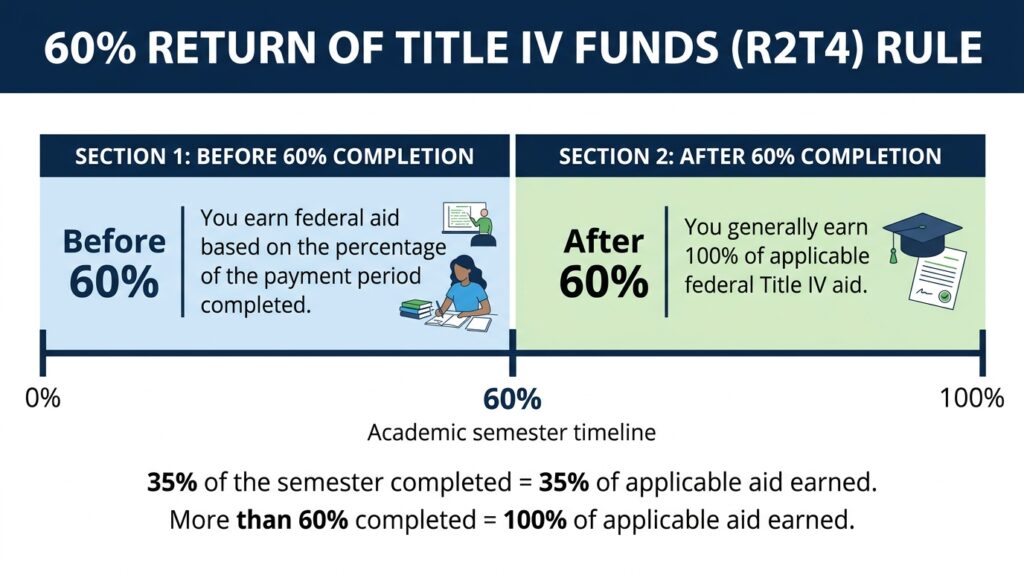
Federal aid is treated as earned over time. For a credit-hour program, the school generally compares the number of calendar days completed with the number of days in the payment period. Before the 60% point, the earned percentage is usually the percentage of the period completed. After the 60% point, the student is treated as having earned 100% of the Title IV aid for that period.
For example, imagine a 100-day semester and a student who withdraws after day 35. The initial earned percentage is 35%. If the student had $4,000 in applicable federal aid, the calculation begins with $1,400 earned and $2,600 unearned. That does not automatically mean the student personally owes $2,600. The school must continue through the full R2T4 formula, including institutional charges and the applicable grant protection rules.
Now imagine the same student withdraws after day 65. Because the student passed the 60% point, the federal calculation generally treats the Title IV aid as fully earned. That does not erase a tuition balance, a separate Pell recalculation, or a satisfactory academic progress issue. It simply changes the federal return calculation for that payment period.
Do not confuse the 60% point with your school’s refund deadline. They may be different dates. A tuition refund schedule answers how much the college refunds in charges. R2T4 answers how much federal aid was earned and how much must be returned.
How a school calculates aid earned after withdrawal
The exact worksheet is handled by the school, but the logic is easier to understand as a sequence:
- Identify the payment period. For a standard semester, this is usually the term or payment period used for federal aid.
- Establish the withdrawal date. This may be the date you begin the official withdrawal process, the date you notify the school, or the documented last date of academic attendance.
- Calculate the percentage of the period completed. Up to the 60% point, time attended drives the earned percentage.
- Determine the amount of Title IV aid earned. The earned percentage is applied to aid disbursed or eligible to be disbursed.
- Determine unearned aid. The difference between total applicable aid and earned aid is the unearned amount.
- Assign responsibility. The school returns the amount it is responsible for, generally beginning with loan programs and then grant programs according to federal rules. Any remaining student responsibility may become a debt to the school or a federal grant overpayment.
One detail surprises many students: aid can sometimes count as “could have been disbursed” even if the money never reached the student, provided the student met the relevant eligibility conditions. The reverse is also true. A student may not qualify for a scheduled disbursement if another requirement was not met.
Why you may owe the college after the school returns aid
Think of your account as having two connected but separate ledgers. One ledger tracks the school’s charges and refunds. The other tracks the federal aid the student earned by attending. When a school returns unearned aid, money that had been applied to tuition may disappear from the student account. The charges do not necessarily disappear with it.
Suppose a college charged $1,500 and applied a $2,000 Pell Grant. If the R2T4 calculation requires the school to return $800, only $1,200 of the original aid remains applied. The student may now have an $300 balance, even though the student did not receive that amount as cash. The actual outcome depends on the school’s calculation, refund policy, and account history.
This is why a financial aid conversation should include the cashier or student accounts office. Ask for both numbers:
- How much federal aid will be returned?
- What balance will remain on my college account after the return and tuition refund are processed?
Some schools may offer a repayment arrangement. Others may place a registration or transcript hold until the balance is resolved. Those are institutional policies, not universal federal rules.
Post-withdrawal disbursements: when the school may still owe you aid
R2T4 is not only about taking aid back. If the calculation shows that you earned more aid than was already disbursed, you may qualify for a post-withdrawal disbursement.
Grant funds may be applied to eligible tuition and fee charges under the school’s procedures. For other charges, the school may need your permission. Loan funds require additional borrower authorization, and accepting them means taking on debt after you have left school. Read the notice carefully before accepting a post-withdrawal loan.
Federal deadlines matter. The school must return the Title IV funds for which it is responsible within the required federal timeframe. It also must notify students about post-withdrawal loan eligibility within the applicable deadline. Your college should explain the amount, the type of aid, the response deadline, and whether the funds would reduce a balance or be sent to you.
Modular courses make withdrawal decisions more complicated
Many community colleges use eight-week, five-week, or other accelerated courses inside a longer semester. These are often called modules. Leaving one short course does not automatically mean you withdrew from the entire payment period, but the school may need to determine whether you had confirmed future attendance in another module.
For example, a student completes a first eight-week class, withdraws from a second class, and is registered for a later class. The later registration or written confirmation may affect whether the student is treated as having withdrawn from the payment period. The timing and the school’s documentation are critical.
Federal guidance also describes withdrawal exemptions for some students in modular programs. A student may avoid being treated as withdrawn if they successfully complete a qualifying portion of the payment period, successfully complete coursework equal to at least the school’s half-time standard, or meet another applicable exemption. These tests are technical. A withdrawal, incomplete, or failing grade generally does not count as successful completion for the relevant exemption.
If you attend a modular program, ask this exact question before withdrawing: “If I leave this course today, what written confirmation or future enrollment do you need to avoid treating me as withdrawn from the payment period?”
Withdrawal is not the same as a Pell recalculation
Students often hear “your aid will be recalculated” and assume every recalculation follows the same rule. It does not.
A Pell recalculation may occur when your enrollment intensity changes, when you do not begin all of the courses used to establish your award, or when your school reaches its Pell recalculation date. A complete withdrawal may trigger R2T4 as well. In some cases, the school must complete an enrollment adjustment before using the revised aid amount in the R2T4 calculation.
That is why it helps to separate the questions:
- What is my final enrollment intensity after the schedule change?
- Did I begin attendance in every course used for my award?
- Am I withdrawing from all Title IV-eligible courses?
- What is my official or unofficial withdrawal date?
- What will my account balance be after both aid and charges are adjusted?
For background on another major eligibility rule, see Student Aid Guard’s guide to the 67% SAP completion pace requirement. A withdrawal can affect academic progress separately from its immediate effect on the current term’s aid.
What to do before submitting a complete withdrawal

Do not rely on a generic online calculator or a friend’s experience. Two students at the same college can receive different results because their withdrawal dates, charges, aid types, attendance records, and module schedules differ.
Use this five-part checklist:
- Ask financial aid for a “what-if” review. Give the office the exact courses you may leave and the date you are considering.
- Ask student accounts for the post-refund balance. Request the estimate in writing if possible.
- Confirm the withdrawal date. Ask what date the school will use and what evidence supports it.
- Ask about future enrollment. This is especially important for modules, compressed terms, and planned returns.
- Ask about state and institutional aid. R2T4 does not answer every question about state grants, scholarships, tuition waivers, or campus aid.
Keep copies of emails, forms, attendance documentation, and the school’s calculation notice. If the result seems wrong, ask the financial aid office to explain the calculation line by line. A useful question is: “Which date, aid amount, and institutional charges did you use, and where can I see those records?”
Common mistakes students make
Assuming dropping one class is a complete withdrawal
Dropping from 12 to 9 credits may change Pell eligibility without triggering the same R2T4 process as leaving every course. The words “drop,” “withdraw,” and “complete withdrawal” are not interchangeable.
Waiting until after the withdrawal to ask questions
A school can explain a likely outcome before you act. It may not be able to reverse a deadline, restore a course seat, or change an official withdrawal date later.
Confusing a tuition refund with an aid return
The refund schedule and R2T4 formula serve different purposes. Read both policies.
Assuming the 60% point guarantees a zero balance
Passing the 60% point generally affects whether federal aid is considered earned. It does not guarantee that tuition, fees, books, or other charges will be fully covered.
Ignoring satisfactory academic progress
Even when a current-term return calculation is manageable, withdrawals can reduce your completion rate. Review the Pell recalculation date guidance and your school’s SAP policy before changing your schedule.
Before you click submit
A complete withdrawal is not just an academic action. It can change the federal aid you are allowed to keep, the balance on your college account, your future eligibility, and the timeline for returning to school. The safest move is to treat the decision like a financial transaction: identify the date, ask for the calculation, and get the answer in writing before you finalize it.
Student Aid Guard is built for this exact moment, when a schedule change could become an expensive surprise. Use the site’s financial aid calculator before you drop, withdraw, go part-time, or add a course.
Frequently asked questions
Do I have to repay Pell Grant money if I withdraw?
Maybe. If you withdraw from all classes before the 60% point, the school calculates how much federal aid you earned. Unearned aid may be returned, and the resulting account balance or grant overpayment may become your responsibility. The school’s calculation is required to determine the actual amount.
What happens if I withdraw after the 60% point?
Usually not by itself if you remain attending another Title IV-eligible class. However, dropping a course can change your enrollment intensity and Pell Grant amount. If you stop attending all eligible coursework, R2T4 may apply.
Does withdrawing from one class trigger Return of Title IV?
For the federal R2T4 calculation, you generally have earned 100% of the applicable Title IV aid after completing more than 60% of the payment period. Your school may still adjust enrollment-based aid, apply its tuition refund policy, or review SAP separately.
Can I receive money after withdrawing?
Possibly. If the calculation shows that you earned federal aid that was not disbursed, the school may offer a post-withdrawal disbursement. Grant and loan rules differ, and accepting a loan requires careful consideration because it creates debt.
How can I find out exactly what I will owe?
Ask both the financial aid office and student accounts office for a written estimate based on your proposed withdrawal date. Request the expected aid return, tuition refund, remaining account balance, and any effect on state or institutional aid.