
QUICK ANSWER:
The Pell Grant disbursement schedule varies by college, so there is no universal payday for every student. Your school must confirm eligibility, enrollment, attendance, and required documents before releasing funds. The grant first pays eligible college charges, and any remaining credit is refunded to you through your selected payment method.
There is nothing more frustrating than counting on your financial aid to cover tuition, books, or rent, only to check your bank account and find that the money still hasn’t arrived. Your financial aid portal says “awarded,” your classes have started, and you’re wondering whether something went wrong. So, when does Pell Grant money actually hit your account?
The answer isn’t always as straightforward as you might expect. The Pell Grant disbursement schedule depends on your college’s academic calendar, enrollment status, attendance confirmation, financial aid requirements, and refund processing procedures. Even if your award has been approved, that doesn’t necessarily mean the money is ready to spend. Your school must first apply the funds to eligible charges before sending any remaining balance to you.
Understanding this process can save you unnecessary stress and help you avoid financial decisions based on money you haven’t received yet. In this guide, you’ll learn when Pell Grant funds are typically disbursed, how long refunds take after disbursement, why payments sometimes get delayed, and what to do if your classmates receive their money before you do. We’ll also explain how dropping a class, withdrawing from college, or changing your enrollment status can affect your payment.
Before you make plans around your expected refund, here’s what you need to know.
Key Takeaways
- No universal payment date: Every college sets its own Pell Grant disbursement schedule within federal guidelines.
- Awarded doesn’t mean paid: Your award must go through eligibility, enrollment, attendance, and documentation checks before disbursement.
- Disbursement and refunds are different: Your school applies Pell funds to eligible charges first, then refunds any remaining credit balance.
- Refunds take additional time: Direct deposits and paper checks may take several business days after disbursement.
- Enrollment changes matter: Dropping or withdrawing from classes can reduce your award, delay payment, or create a balance.
- Check your student account: Your financial aid portal, account ledger, and college disbursement calendar can help you identify what’s delaying your money.
Disbursement is not the same as a refund
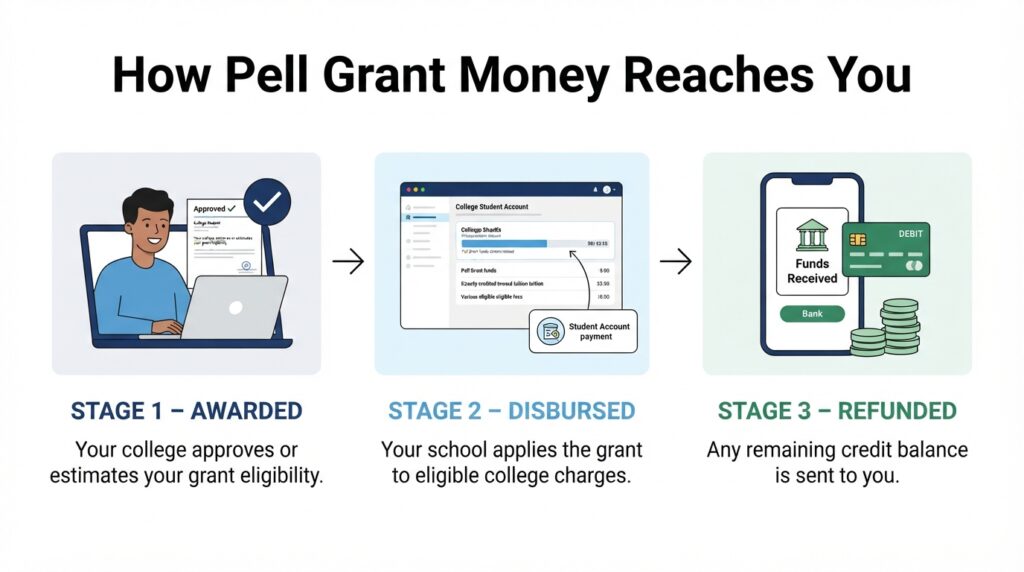
Students often use “my Pell money arrived” to describe three different events. That shorthand can create expensive confusion, especially when a college posts aid before the money is available in your bank account.
1. Your award is accepted
An award notice may show an estimated Pell Grant amount for fall, spring, or summer. It can still be conditional. Verification, citizenship or eligibility checks, enrollment changes, SAP review, an outstanding document, or an unresolved balance can delay the next step.
2. Your school disburses the grant
Disbursement means the school releases the aid into your student account. The funds generally pay eligible tuition, fees, and other institutional charges first. Your portal may show a financial aid credit even though no cash has been sent to your bank.
3. Your school issues a refund
If your aid exceeds your eligible charges, the remaining credit becomes a refund. The college may send that balance by direct deposit, debit card, or paper check. The refund schedule is controlled by the institution and its payment processor, not by the FAFSA form itself.
How a Pell Grant disbursement schedule usually works
There is no single national date when every community college releases Pell Grant funds. Instead, schools build a payment timeline around the academic calendar and their ability to confirm a student’s eligibility. A typical sequence looks like this:
- You submit the FAFSA and complete any required verification.
- Your college receives federal aid information and creates an award.
- You register for eligible coursework in an approved program.
- The school reviews enrollment intensity, SAP, documents, and other holds.
- Classes begin, and the school may confirm attendance or participation.
- The Pell Grant posts to your student account on the college’s disbursement date.
- Tuition and fees are paid, then a remaining credit is processed as a refund.
- Your bank or payment provider delivers the refund according to its own processing time.
Some colleges use one major disbursement. Others split the award into multiple payments, particularly when a term has late-start classes, short sessions, or an attendance requirement. A published date may also be the date the school begins processing, not the date your bank makes the deposit.
How early can a school disburse Pell Grant funds?
Federal Student Aid guidance sets limits on when a school can pay out federal funds. The federal handbook explains that the earliest a school may disburse a Pell Grant is generally 10 days before the first day of classes in the payment period. That rule is a ceiling on early payment, not a guarantee that your college will use the earliest possible date.
Read the Federal Student Aid guidance on disbursing Pell Awards for the federal framework. It is authoritative, but it cannot tell you whether your college releases funds on Monday, after attendance is confirmed, or in two installments. Your financial aid office and published disbursement calendar answer that local question.
Why your Pell Grant may be delayed
A delayed payment does not automatically mean you lost your grant. It often means one part of the eligibility chain is not finished. Before assuming the worst, check these common causes.
FAFSA or verification is incomplete
Your college may not release federal aid until required documents are submitted and reviewed. A missing tax document, identity confirmation, transcript, or professional judgment item can leave an award in a pending status.
You changed your enrollment
Pell Grant amounts can change when you add, drop, withdraw from, or stop attending a class. The school may need to recalculate your enrollment intensity or determine whether the course applies to your program. Read how dropping below 12 credits changes Pell Grant before treating your original award as final.
You have a SAP issue
Satisfactory Academic Progress usually includes GPA, completion pace, and maximum timeframe. If your status is warning, probation, or suspension, your college may need a review or appeal decision before disbursing aid. A registration confirmation does not override a SAP decision.
Your college is confirming attendance
Some schools wait for faculty attendance reporting, participation activity, or a defined academic engagement check. Online and late-start courses can be reviewed on a different timeline from traditional courses. Ask what your college means by attendance because simply being registered may not be enough for its process.
You have a hold or balance
An admissions, academic, financial aid, loan counseling, or account hold can pause processing. The hold may not be related to Pell eligibility, but it can still block payment or refund. Check the exact message in your student portal instead of relying on a general “aid pending” label.
What the college does with Pell Grant money first
When federal aid is disbursed, the school generally applies it to allowable institutional charges. Depending on the college and the type of charge, that may include tuition and required fees. If the credit is larger than the charges, the remaining amount is a credit balance that must be returned to you under the school’s refund process.
That is why an award of $3,000 does not necessarily mean a $3,000 deposit. Suppose your term charges are $1,850 and your eligible Pell payment is $3,000. The school may apply $1,850 to your account and issue a refund of the remaining $1,150, assuming no other charges, adjustments, or aid changes apply. The numbers here are an illustration, not a prediction of your award.
Some schools also require authorization before using federal aid for certain non-tuition charges. If your portal shows a smaller refund than expected, ask for an account ledger that separates charges, aid credits, adjustments, and refund transactions.
How long after disbursement does a Pell refund take?
After a Pell Grant posts to your student account, a refund may still take additional business days. The timing depends on when the school identifies a credit balance, when it sends the payment file, and whether you chose direct deposit or paper check. A bank can also add processing time.
One community college, BMCC, explains that financial aid is posted before refunds are issued and tells students to account for that time lag. Its published process is a useful example of the difference between account posting and cash delivery, but it is not a universal schedule. Compare it with your college’s own Pell Grant payment information only to understand the structure, not to predict your date.
If you are asking “how long does a Pell Grant refund check take,” first identify which stage you are waiting for. Is the award still pending? Has it posted to your account? Does the account show a credit balance? Has the school marked the refund as sent? Each answer points to a different office and a different next step.
Why two students can receive Pell money on different dates
Students often compare deposits and assume the college made a mistake because a classmate was paid first. That conclusion may be wrong. The college may process students in groups based on enrollment, completed documents, course start dates, attendance records, or refund method.
- You and your classmate may have different credit loads.
- One student may have completed verification earlier.
- One schedule may include a late-start or short-session course.
- One account may have an unresolved balance or hold.
- One refund may use direct deposit while the other uses a paper check.
- A schedule change may have triggered a recalculation for only one student.
The fair comparison is not “Did my friend get paid?” It is “What exact requirement is still pending on my account, and what date applies once it is complete?”
What happens if you drop a class before disbursement?
A schedule change before the initial payment can change the amount the college is allowed to disburse. If you move from full-time to three-quarter-time or half-time enrollment, your Pell calculation may change. The school may also review whether your remaining courses apply to your program.
The exact result depends on the college’s recalculation date and the type of change. A drop during the add/drop period is not always treated like a withdrawal after the term begins. For a practical comparison, read dropping versus withdrawing and why timing matters for your financial aid check and the guide to Pell Grant recalculation dates.
Do not submit a schedule change based on the refund you hope to receive. Ask the aid office to model the proposed schedule first. Give them the course numbers, session dates, current credits, and date you plan to make the change. A written estimate is much safer than a verbal guess.
What happens if you withdraw after Pell is disbursed?
Withdrawing after aid posts can create a different set of questions. If you remain enrolled in at least one class, your college may review the effect on enrollment intensity, eligibility, SAP, and the balance on your account. If you stop attending all classes, the school may have to perform a Return to Title IV calculation.
A Return to Title IV review measures how much federal aid you earned based on the portion of the payment period you attended. It can result in funds being returned to the Department of Education and a balance being placed on your account. That is not the same process as an ordinary refund delay.
The important point is timing. “The Pell money already arrived” does not mean the payment is permanently yours if your enrollment or attendance later changes. Contact your financial aid office before withdrawing, especially if the withdrawal would leave you with no active classes.
How enrollment intensity affects your expected payment
Pell Grant calculations use enrollment intensity. Many community colleges describe full-time, three-quarter-time, half-time, and less-than-half-time levels, but the amount depends on your award and the applicable federal calculation. A credit total alone cannot tell you the exact refund.
| Enrollment question | Why it matters to your payment |
|---|---|
| How many eligible credits are you taking? | Enrollment intensity can affect the scheduled Pell amount. |
| Do the courses apply to your program? | Registration and aid-eligible enrollment may differ. |
| When do the courses begin? | Late-start sessions can have separate review or payment timing. |
| Have you changed the schedule? | A drop or withdrawal can trigger recalculation. |
| Have you completed SAP and verification? | Unresolved eligibility items can delay disbursement. |
Use the table as a checklist, not as a personal award calculator. The financial aid office has access to your Student Aid Index, annual eligibility, lifetime usage, program status, and institutional rules.
A realistic example of a delayed Pell refund
Imagine Maya sees a $3,200 Pell award in her portal for the fall term. She assumes the money will be in her checking account on the first day of class. The school’s calendar says federal aid begins disbursing after the term starts, and Maya still has one verification document marked incomplete.
Maya submits the document, but the office needs time to review it. Once her file is complete, the school confirms that her 12 credits apply to her program and posts the award to her account. The college then pays $1,900 in eligible charges and sends the $1,300 credit balance for refund processing. Her bank receives the direct deposit later.
Maya experienced one delay, not one lost grant. Her original mistake was treating the award notice, disbursement, and refund as the same event. A better plan would have been to ask for the school’s disbursement date, the outstanding requirement, and the estimated refund processing time.
What to check in your student portal
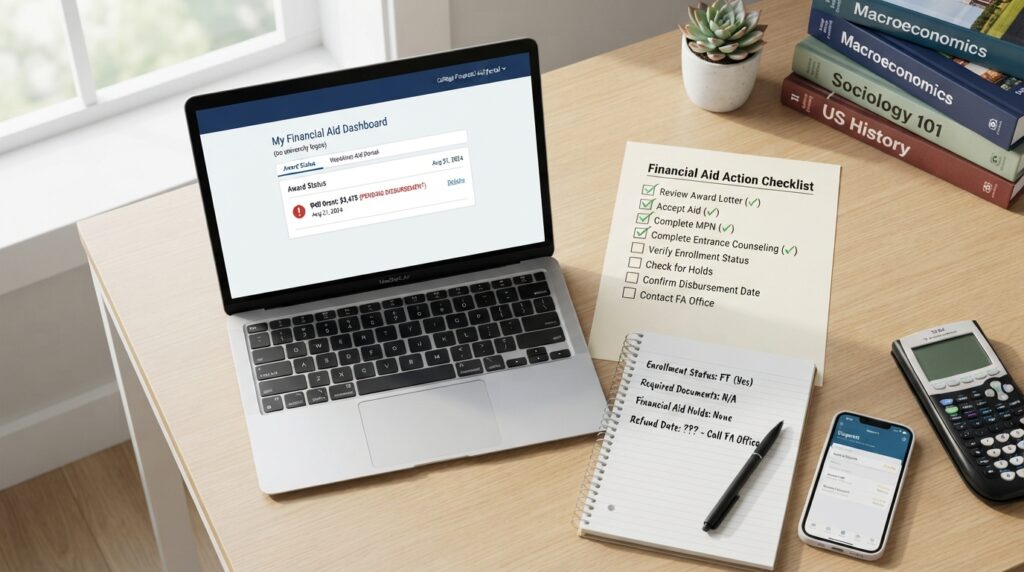
- Aid status: look for accepted, estimated, authorized, scheduled, disbursed, or canceled language.
- Required documents: open every checklist item, not just the headline status.
- Enrollment: compare the credits on your award with the credits you are actually attending.
- Account ledger: identify tuition, fees, aid credits, adjustments, and refunds separately.
- Holds: read the detail behind any registration, financial, or academic hold.
- Refund preference: confirm that your direct deposit information is current.
- Messages: search for notices about attendance, SAP, verification, or census dates.
Take a screenshot or download the ledger when the status changes. If an amount later changes, you will have a clearer record of what the college showed and when.
What to ask the financial aid office
A vague question such as “Where is my money?” may produce a vague answer. Use questions that identify the step you need:
- What is the published Pell Grant disbursement date for my payment period?
- Has my Pell Grant been disbursed to my student account, or is it still scheduled?
- Is any verification, SAP review, attendance confirmation, or other requirement incomplete?
- What enrollment level is being used for my current Pell calculation?
- What is my current account credit balance after charges?
- Has my refund been sent, and what delivery method is listed?
- If I drop or withdraw from this course, will my Pell amount or balance change?
If you speak by phone, write down the date, the staff member’s name, the exact status, and the next action. If the amount is significant, follow up through the college’s secure message system or email so you have a written record.
Common mistakes that make disbursement problems worse
Budgeting from an award notice
An award notice is useful for planning, but it is not spendable cash. Build your immediate budget around money you already have, not a refund date you have not confirmed.
Dropping a class to make the refund arrive faster
A drop can reduce enrollment intensity or trigger a recalculation. It may solve one schedule problem while creating a balance due. Ask for the new aid calculation first.
Assuming the federal government sets your college’s date
Federal rules establish important boundaries, but your college determines its operational calendar, documentation process, attendance review, and refund delivery. Use Federal Student Aid for the framework and your college for the date.
Ignoring a small hold
A missing form or account hold can delay a large grant. Open the details and resolve every item you can. If the portal is unclear, ask which hold specifically blocks disbursement.
How advisors can explain Pell timing more clearly
For advisors and administrators, the best explanation separates the student’s financial aid timeline from the academic calendar. “Aid is coming soon” is not actionable. Students need four dates or statuses: when eligibility is reviewed, when funds post to the account, when a credit balance is identified, and when the refund is sent.
Advisors can also reduce risk by asking students to report planned schedule changes before they submit them. A student deciding between a late-start course and an early withdrawal needs an enrollment review, not just a registration recommendation. That small handoff between advising and financial aid can prevent a surprising bill.
How to plan around a Pell Grant payment
- Find your college’s current financial aid disbursement calendar.
- Confirm your FAFSA, verification, SAP, and enrollment requirements are complete.
- Check whether all registered courses apply to your program.
- Ask when your aid posts to the account, not only when the refund is sent.
- Confirm your direct deposit or refund preference.
- Review your account ledger after disbursement.
- Contact financial aid before any drop, withdrawal, or part-time change.
- Keep a written record of dates, amounts, and instructions.
The safest way to think about Pell timing
A Pell Grant has a chain of events, not one magic payday. Eligibility must be established, enrollment must be reviewed, funds must post to your account, charges must be paid, and any credit balance must be refunded. Each link has its own timing.
So before you budget around a Pell refund or change your schedule, verify the exact status of your account. If you are considering a drop, withdrawal, added course, or move to part-time enrollment, start with the financial aid impact stimulator and subscribe to the Student Aid Guard for practical guidance before your next schedule change, and share this guide with a classmate who is waiting for aid money that has not arrived yet.
This approach may feel overly cautious. In my experience, it is the difference between a manageable timing issue and a crisis caused by a rent payment, textbook purchase, or work decision built on an assumed deposit.
FAQ: Pell Grant disbursement schedule
Does Pell Grant money go directly to my bank account?
Usually, the school applies the grant to your student account first. If the aid exceeds eligible charges, the remaining credit is refunded through your selected delivery method. It may be direct deposit, a payment card, or a paper check.
How early can Pell Grant be disbursed?
Federal guidance generally allows a school to disburse Pell no earlier than 10 days before the first day of the payment period. Your college may choose a later date based on enrollment, attendance, verification, and its own calendar.
Why does my financial aid say awarded but not disbursed?
“Awarded” usually means the college has listed estimated or approved eligibility. “Disbursed” means the funds have posted to your student account. Missing documents, SAP review, attendance confirmation, enrollment changes, or a hold can keep an award from disbursing.
Can a schedule change delay my Pell refund?
Yes. Adding, dropping, or withdrawing can trigger a new enrollment or eligibility review. The amount may change, the payment may pause, or a credit balance may be recalculated. Ask your financial aid office for the effect before changing your schedule.
What should I do if my Pell refund is late?
Check your aid checklist, account ledger, holds, enrollment, refund preference, and college disbursement calendar. Then ask whether the grant has posted, whether a credit balance exists, and whether the refund has been sent. Those three questions identify the next office to contact.