
Few things are more stressful than worrying about how you will pay for college after a difficult semester. When your grades slip, the fear of losing financial aid can quickly turn into anxiety about whether you can afford to continue your education. And if your Pell Grant or federal student loans are covering your tuition, even one disappointing semester can leave you wondering what happens next.
So, what GPA do you need to keep financial aid?
The answer is not always as straightforward as you might think. While many community colleges require a minimum 2.0 cumulative GPA, your grades are only one part of the equation. Colleges also evaluate your Satisfactory Academic Progress (SAP), which includes how many attempted credits you successfully complete and whether you are on track to finish your program within the permitted timeframe.
In this guide, you’ll learn what GPA you need to maintain financial aid eligibility, how SAP requirements work, and what happens when your grades fall below the required standard. We’ll also explain the difference between financial aid warning, suspension, and probation, how withdrawals and repeated courses affect your eligibility, and whether you can appeal a financial aid suspension.
Whether you’re worried about a recent drop in grades or simply want to protect your financial aid before registering for another semester, this guide will help you understand the rules and make informed decisions.
Key Takeaways:
- A 2.0 GPA is common, but not universal: Your college determines the minimum cumulative GPA required to maintain financial aid eligibility.
- GPA isn’t the only requirement: Most schools also require students to complete approximately 67% of attempted credits and stay within the 150% maximum timeframe.
- Financial aid warning gives you an opportunity to recover: You may continue receiving aid for another payment period while working to meet SAP requirements.
- Suspension can stop your financial aid: However, you may regain eligibility by meeting SAP standards or submitting an approved appeal.
- Withdrawals and repeated courses matter: They can affect your completion rate, cumulative GPA, and overall eligibility differently.
- Check before changing your schedule: Contact your financial aid office for a written assessment before dropping, withdrawing from, or repeating a course.
What GPA do you need to keep financial aid?
Most community colleges require a cumulative GPA around 2.0 to remain in good financial aid standing, but there is no nationwide GPA cutoff that applies to every student. Your college sets and publishes its SAP policy. That policy may use a 2.0 standard for students who have attempted 33 or more credits while allowing a 1.5 or 1.75 threshold earlier in a program. You must also meet the college’s completion-rate and maximum-timeframe rules.
That answer is intentionally less tidy than the advice you may see on social media. Federal rules require an institution to establish reasonable SAP standards, but schools implement those standards through their own catalogs and financial aid offices. The federal framework does not simply say, “Earn a 2.0 every term and you are safe.”
Why a 2.0 GPA is common, but not universal
A 2.0 is a common benchmark because it represents a cumulative C average on a traditional four-point scale. For example, Morgan Community College publishes a 2.0 cumulative GPA standard alongside a 67% completion requirement. Houston City College also describes a 2.0 cumulative GPA and 67% pace as core SAP measures.
But a college can use a progression-based standard. Enterprise State Community College, for example, describes different GPA thresholds based on attempted hours: 1.5 for students with 1 to 21 attempted hours, 1.75 for 22 to 32 hours, and 2.0 at 33 or more hours. That kind of schedule recognizes that a student in a first term has had less time to build a cumulative average.
This is why your student portal, catalog, and financial aid policy matter more than an internet calculator. Ask these questions before you assume your GPA is acceptable:
- Does the policy use cumulative GPA, term GPA, or both?
- Does the GPA threshold change after a certain number of attempted credits?
- Are transfer, remedial, repeated, or academic-renewal courses included?
- Does an incomplete count as attempted credit while it is unresolved?
- Does your program have a separate rule for short-term certificates?
SAP is more than your GPA
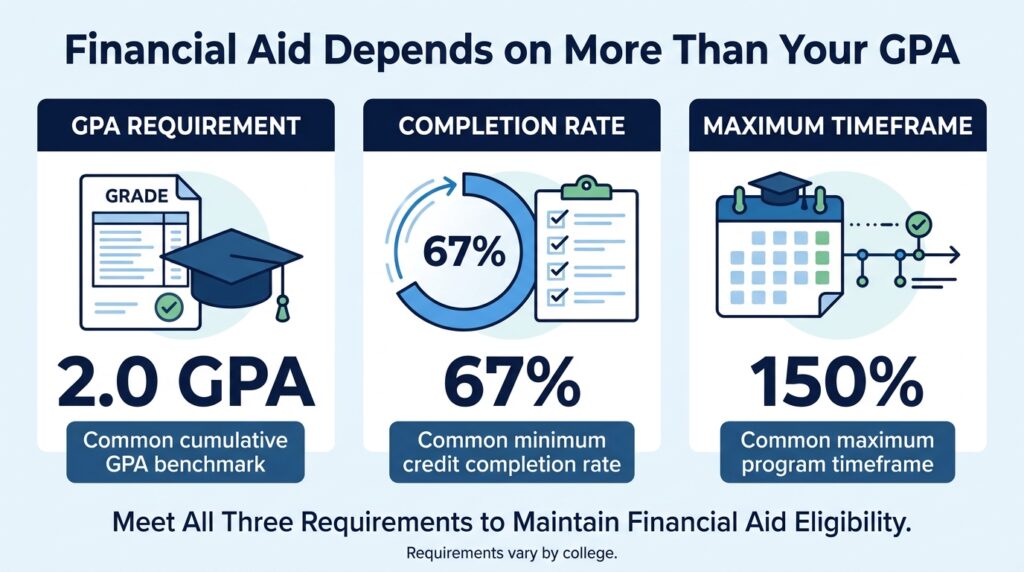
Think of SAP as a three-legged stool. Your GPA is one leg, but completion pace and maximum timeframe are the other two. A strong GPA will not necessarily preserve aid if you repeatedly withdraw from courses or attempt too many credits for your program.
1. Qualitative standard: cumulative GPA
The qualitative standard measures the quality of your academic work. Most schools express it as a cumulative GPA. Some also require you to earn a minimum term GPA while you are on financial aid warning, probation, or an academic plan.
A cumulative GPA can move slowly. If you have 30 credits at a 2.0 and earn a 1.0 term GPA over 12 additional credits, your new cumulative average will be about 1.71, not 1.0. That is why a single rough semester may not immediately cause suspension, while several rough terms can create a problem even after a later improvement.
2. Quantitative standard: completion rate or pace
The quantitative standard asks whether you are completing enough of the credits you attempt. A common benchmark is 67%, calculated as completed credits divided by attempted credits. If you attempt 30 credits and successfully complete 21, your pace is 70%. If you complete only 18, your pace is 60%.
Grades such as F, W, I, and some administrative withdrawals may count as attempted but not completed. That means a withdrawal can protect your GPA in some situations while still lowering your completion rate. Our guide on dropping versus withdrawing and your financial aid check explains why the timing and type of schedule change can matter.
3. Maximum timeframe
Federal SAP rules also require schools to measure whether you can finish within a reasonable maximum timeframe. A common ceiling is 150% of the published credits in your program. For a 60-credit associate degree, that could mean 90 attempted credits. Transfer credits accepted toward the program, repeats, withdrawals, and credits from earlier programs may count according to your school’s policy.
Maximum timeframe is easy to overlook because it has nothing to do with your GPA. A student with a 3.5 average can still lose aid after exhausting the credits allowed for the program. If you are changing majors or returning after several semesters, ask how your previous attempts are being counted.
Does term GPA or cumulative GPA determine financial aid eligibility?
Usually, the cumulative GPA is the main SAP measure, but the exact answer depends on your school and status. A student in good standing may be evaluated using cumulative measures at the end of each term. A student on warning or probation may also have to meet a term GPA, pass a required percentage that term, or follow an academic plan.
Here is the distinction:
- Term GPA: your average for one semester or payment period.
- Cumulative GPA: your average across the coursework your school includes in its policy.
- Academic-plan measure: a customized requirement you must meet after an approved SAP appeal.
You could earn a 2.5 term GPA and still remain below a 2.0 cumulative GPA. Conversely, you could have a cumulative GPA above 2.0 but fail the completion-rate requirement. Never interpret one number without checking your full SAP status.
What happens if your GPA falls below the financial aid requirement?
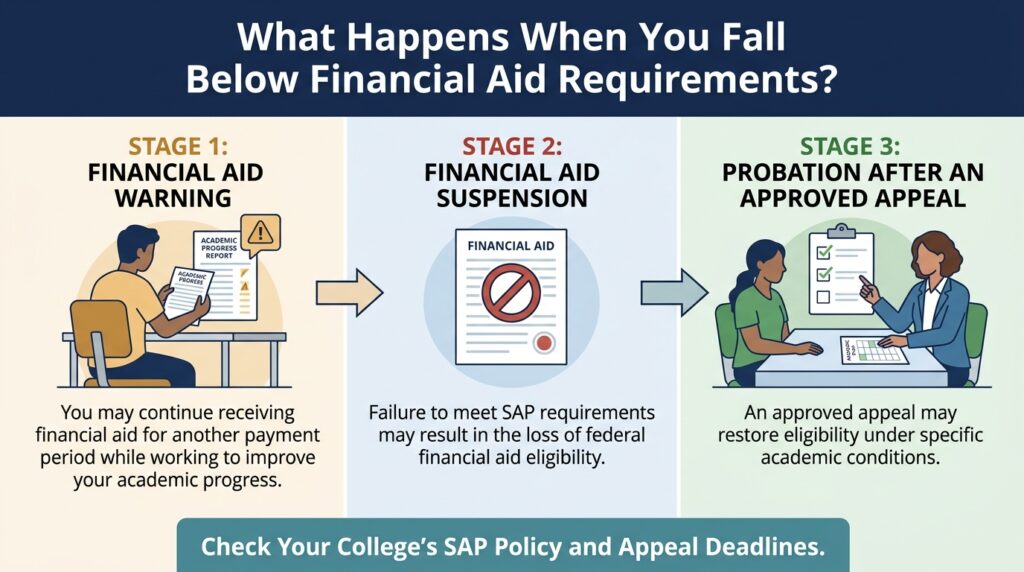
Most schools use a sequence such as good standing, warning, suspension, and probation after an approved appeal. The names and timing vary, but the basic logic is similar: the school identifies a SAP problem, gives you a defined opportunity to recover in some cases, and stops aid if the problem continues.
Financial aid warning
Warning is often a one-payment-period grace period. You may continue receiving aid while you improve your GPA or completion pace. Warning is not a promise that your aid is safe for the rest of the year. Treat it like a smoke alarm, not a permission slip.
Financial aid suspension
If you do not meet the required standard after warning, your school may place you on suspension or ineligible status. Federal grants, loans, and work-study can be affected. Your school may also cancel anticipated aid or require another payment arrangement before your courses are protected from being dropped.
Probation after an appeal
An approved SAP appeal may restore aid under probation or an academic plan. That status usually comes with conditions, such as earning a minimum term GPA, completing every course, or following a prescribed course schedule. Missing the plan can return you to suspension even if your cumulative GPA has improved.
How schedule changes can affect your GPA and aid
Students often search for a GPA answer after they are already considering a schedule change. That is the right moment to pause. Dropping before the add/drop deadline may remove a course from your record. Withdrawing later may produce a W that does not lower GPA but can reduce your completion rate. Failing the course can affect both.
Your enrollment level can also change your current-term award. Dropping below full time may reduce a Pell Grant because Pell eligibility is tied to enrollment intensity. Read our guide to how dropping below 12 credits changes Pell Grant eligibility before you submit the change.
A schedule change can also trigger a Pell recalculation or a return-of-funds review if you withdraw from all classes. Our explanation of the Return to Title IV process after withdrawing covers a different question from SAP, but both can affect your account. Do not assume that meeting the GPA rule means your current award will remain unchanged.
How to calculate your GPA before the SAP review
You can estimate your term GPA by multiplying each course’s credit hours by the grade points for that grade, adding those quality points, and dividing by total graded credit hours. A common scale assigns A = 4, B = 3, C = 2, D = 1, and F = 0, but your college may use plus and minus grades differently.
For example, imagine a 12-credit term with three four-credit courses. A B, a C, and an F would produce 20 quality points, or a 1.67 term GPA. That estimate does not tell you your official cumulative GPA because your prior credits and your school’s repeat policy still matter.
For a useful planning conversation, bring your unofficial transcript and ask financial aid to calculate three scenarios:
- What happens if you finish every remaining class?
- What happens if you withdraw from one class?
- What happens if you repeat or fail the course?
What grades count toward financial aid SAP?
There is no universal treatment for every grade. In many policies, A through D or passing grades count as completed, while F and W count as attempted but not completed. An incomplete may count as attempted until a final grade is posted. Repeated coursework can affect both GPA and pace, and transfer credit may count toward pace or maximum timeframe even when it does not enter your institutional GPA.
Do not rely on academic forgiveness to erase a SAP problem. Federal SAP reviews may require the college to consider your complete academic history, including periods when you did not receive aid. Ask whether the following are included in your school’s calculation:
- Courses taken before you filed the FAFSA
- Transfer credits accepted into your program
- Repeated courses
- Developmental or remedial coursework
- Summer coursework
- Withdrawals and incompletes
What to do if you are close to losing financial aid
First, find the official SAP status in your student portal and read the notice. It should identify the failed measure, the effective term, and any appeal deadline. If the notice only says “not making progress,” contact financial aid and ask for the actual GPA, completion-rate percentage, and attempted-credit total used in the review.
Next, meet with an academic advisor before registering for or dropping another class. The goal is not to take the maximum number of credits. The goal is to choose a schedule you can complete successfully while staying on track for your credential.
- Use tutoring, office hours, disability services, counseling, or emergency support early.
- Ask about an incomplete only when a documented situation makes it appropriate and you understand the deadline.
- Do not stop attending without completing the school’s withdrawal process.
- Keep copies of emails, medical documentation, employment changes, and other records relevant to an appeal.
- Ask for written confirmation of how a schedule change affects aid before submitting it.
Can you appeal financial aid suspension because of a low GPA?
Often, yes, if your college allows SAP appeals and you can document an extenuating circumstance. A successful appeal usually needs two pieces: an explanation of what prevented you from meeting SAP and a credible plan showing what has changed. Simply saying that you need the grant to stay enrolled is usually not enough.
Possible documentation can include medical records, an obituary, a statement from a counselor, proof of a major work-schedule change, or other records your college accepts. Policies vary, and an appeal is never automatic approval. For a deeper look at the process, read our guide to the 67% SAP completion pace rule and then follow your school’s own form and deadline.
Why financial aid administrators and advisors should explain the whole rule
For advisors and financial aid teams, “You need a 2.0” is memorable but incomplete. Students make high-stakes choices based on that sentence. They need to know whether the rule is cumulative, whether their warning period continues, how a W affects pace, and whether the course they want to add counts toward the program.
The best advising conversation is a scenario review, not a citation of policy language. Show the student how each option changes credits attempted, credits completed, GPA, enrollment intensity, and maximum timeframe. That is how a confusing policy becomes a decision a student can actually use.
The bottom line: check your school’s number before you act
So, what GPA do you need to keep financial aid? At many community colleges, the answer is a 2.0 cumulative GPA. But the answer you can safely act on is your college’s complete SAP standard: GPA, completion pace, maximum timeframe, and any special conditions attached to warning or probation.
My strongest advice is simple: do not wait for a cancelled award to start asking questions. Before you drop, withdraw, repeat, add, or change a program, request a written projection from financial aid and academic advising. A ten-minute conversation can protect a semester of eligibility, prevent an avoidable balance, and give you a plan you can follow.
If this guide helped you understand your risk, save it for your next registration decision and share it with a classmate who is weighing a schedule change. StudentAidGuard is built to help community college students understand the financial aid consequences before they act.
Frequently asked questions
Is a 2.0 GPA required for all financial aid?
No. A 2.0 cumulative GPA is common, but each college publishes its own SAP policy. Some schools use lower GPA thresholds for students early in a program, while others apply a 2.0 standard from the beginning. Your official school policy controls.
Can I keep financial aid with a 1.5 GPA?
Possibly, depending on your attempted credits, program, and SAP status. A 1.5 GPA may meet an early-program threshold at some colleges, but it may fail the standard at another school. You must also meet completion-rate and maximum-timeframe requirements.
Does one bad semester cancel financial aid?
Not necessarily. Your cumulative GPA and completion rate determine how much one semester changes your standing. Many colleges use a warning period after a first failure, but some circumstances can lead directly to suspension. Check your SAP notice instead of guessing.
Does withdrawing from a class lower my GPA?
A withdrawal often does not lower your GPA, but it may count as attempted and uncompleted credit. That can reduce your SAP completion rate. It can also change enrollment intensity or trigger a separate aid recalculation, so ask financial aid before withdrawing.
How can I regain financial aid after suspension?
You may regain eligibility by meeting your college’s SAP standards through coursework, or through an approved appeal and academic plan if the school permits it. Sitting out a semester or paying cash does not automatically repair SAP. Ask your financial aid office what exact measure you must satisfy.
Sources: Electronic Code of Federal Regulations, 34 CFR 668.16 and Federal Student Aid guidance on staying eligible.